Showing posts with label Future Technology. Show all posts

Elon Musk’s Neuralink gets $27 million to build brain computers

Elon Musk’s Neuralink gets $27 million to build brain computers


Neuralink, the startup co-founded by Elon Musk, has taken steps to sell as much as $100 million in stock to fund the development of technology that connects human brains with computers


San Francisco: Neuralink Corp., the startup co-founded by billionaire Elon Musk, has taken steps to sell as much as $100 million in stock to fund the development of technology that connects human brains with computers.
The San Francisco-based company has already gotten $27 million in funding, according to a filing with the US Securities and Exchange Commission. Musk said via Twitter on Friday that Neuralink isn’t seeking outside investors. A spokesman didn’t respond to questions about the source of the funds.
Musk, 46, is the chief executive officer of Tesla Inc. and Space Exploration Technologies Corp. and has several other pet projects, including a venture to bore tunnels for roads or tube-based transportation systems known as the hyperloop, and another project for the responsible development of artificial intelligence.
In June, Musk said Neuralink is a priority after much more demanding commitments to his automotive and rocket companies. “Boring Co. is maybe 2% of my time; Neuralink is 3% to 5% of my time; OpenAI is going to be a couple of percent; and then 90-plus percent is divided between SpaceX and Tesla,” said Musk at the electric-car maker’s annual shareholder meeting.
Few details are known about Neuralink. The company’s sparse website says it’s “developing ultra-high bandwith brain-machine interfaces to connect humans and computers.” It’s also recruiting engineers and scientists to join the effort.
“No neuroscience experience is required: talent and drive matter far more,” the company says on the site. “We expect most of our team to come from other areas and industries.” Bloomberg
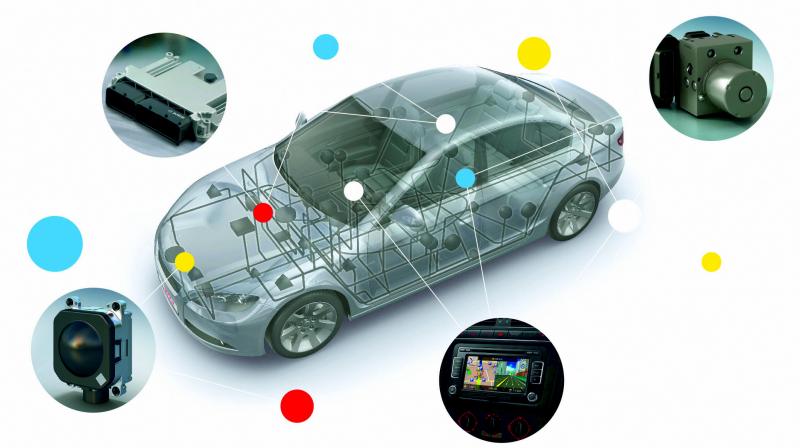
Technology in your car: 8 safety features that depend on tech

Technology in your car: 8 safety features that depend on tech

With the advent of technology and computerisation, abbreviations like ABS, EBD and ESP are nowadays thrown into car brochures and news reports with abandon. But since not everyone is familiar with all of them and how they work, let’s demystify some of them today.


With the advent of technology and computerisation, abbreviations like ABS, EBD and ESP are nowadays thrown into car brochures and news reports with abandon. But since not everyone is familiar with all of them and how they work, let’s demystify some of them today.

ABS / Anti-Lock Braking System

A great boon especially in the wet, ABS prevents the wheels from locking up when you hit the brakes hard. Using pumps and sensors, ABS applies the brakes in several small doses in tricky conditions, thus giving you more control when you brake and also reducing your braking distance.

EBD / Electronic Brake-Force Distribution

When you apply brakes, the force has to be divided among all the tyres based on how much grip they can offer. The tyres that have the most weight on them offer the best grip because the load pushes them into the road more, and hence, when you press your brakes, EBD activates before ABS kicks in and automatically sends more braking power to those tyres.


BA / Brake-Assist

Simply put, BA is like a brake amplifier. When you press the brake in a manner that is sharper and quicker than usual, the system detects an emergency and the brake strength applied is greater than the pressure on the brake pedal, making up for errors in judgement/delayed reaction by the driver.

TCS / Traction Control System

TCS is an important feature in more powerful cars as their grunt delivery can prove to be too much for the tyres to handle. If an individual wheel moves faster than other, TCS detects this and automatically applies a dab of the brakes to that particular wheel to stop it from spinning out of control.

ESP / Electronic Stability Program

ESP monitors your inputs and compares it to the vehicle’s actual behaviour to keep your car stable. If there’s a difference in the steering wheel’s angle and the direction the car is moving in, ESP will control the power and braking strength sent to each wheel using various sensors.

HHC / Hill-Hold Control

HHC uses sensors to determine if your car has stopped at an incline/decline and holds the brakes for a few seconds even if you let go of it. This gives you enough time to get back on the accelerator and move ahead, without the risk of rolling away.

TPMS / Tyre Pressure Monitoring System

TPMS is the most self-explanatory of this lot. It checks your tyre pressure to ensure that your car offers the best grip, handling, comfort and stability, warning you if the pressure dips below the required level.

SRS / Supplemental Restraint System

SRS, which basically means airbags in layman’s terms, is a bit different from the other features here in that, while the others try to prevent an accident from happening, it tries to protect you when and if you do get into an accident.